Why Your First Crochet Project Is Still Sitting in That Bag — And What to Do About It
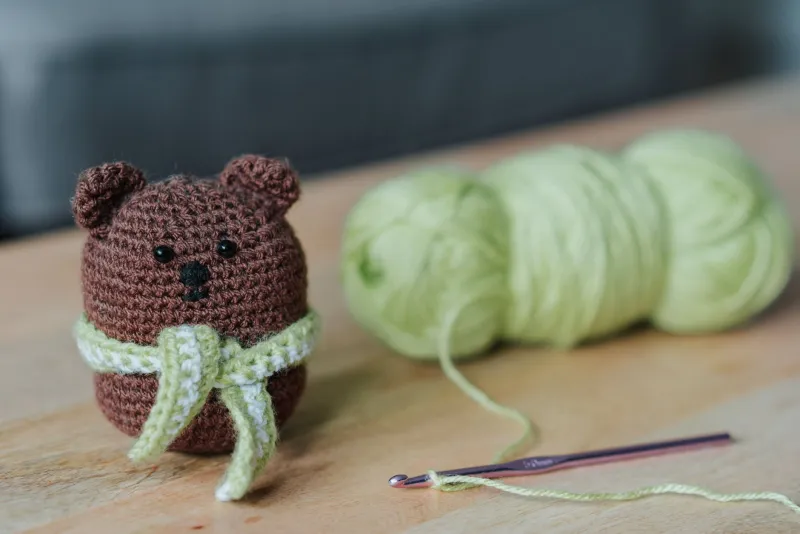
You bought the yarn. You watched approximately forty-seven YouTube tutorials. You cast on, worked a few rows, and then... life happened. Or the tension got weird. Or the pattern stopped making sense somewhere around row eight. Now that little bundle of half-finished yarn is living in a tote bag by your couch, silently judging you every time you walk past.
Sound familiar? You are absolutely not alone. The abandoned first project is practically a rite of passage in the crochet world, and there are real, legitimate psychological reasons it happens. The good news? Once you understand what's going on in your head, getting back on that hook becomes a whole lot easier.
The Perfectionism Trap (It's More Common Than You Think)
Here's something nobody tells beginners: perfectionism is the number one crochet killer. Not tangled yarn. Not complicated stitches. Perfectionism.
When you're new to a craft, your brain is doing something called skill acquisition, and it's genuinely uncomfortable. You can see the beautiful finished objects on Pinterest. You know what good crochet looks like. But your hands aren't there yet — and that gap between what you envision and what you're producing? That's called the "taste gap," and it's a concept popularized by Ira Glass when talking about creative work. He basically said that every beginner has good taste before they have good skills, and that discomfort is actually a sign you care.
The problem is when that gap makes you put the project down entirely. If you catch yourself thinking, this looks terrible, I'm not good at this, try reframing it: this looks like a first attempt, which is exactly what it is. Give yourself permission to make something imperfect. That lumpy dishcloth? It still cleans dishes. That wobbly swatch? It still taught your hands something.
Tension Anxiety Is Real — Here's Why It Happens
Ask any beginner what stresses them out most, and "tension" is almost always on the list. Too tight, too loose, inconsistent — tension issues can make a project look nothing like the photo, and that's genuinely frustrating.
But here's what's happening physiologically: when you're anxious or concentrating too hard, your muscles tense up. Your grip on the hook tightens. Your yarn hand stiffens. And ironically, the more you think about having good tension, the worse it often gets. It's the same phenomenon as when someone tells you not to think about a pink elephant.
The fix isn't to try harder — it's to relax more intentionally. A few things that actually help:
- Work in short sessions. Fifteen minutes of relaxed crocheting beats an hour of white-knuckling it.
- Put on something familiar in the background — a podcast you've heard before, a comfort show, familiar music. Occupying the anxious part of your brain with something low-stakes frees up your hands.
- Swatch without stakes. Make a small square just to practice, with no intention of it becoming anything. This removes the pressure of a "real" project.
- Check your hook size. Seriously, sometimes tension problems are just a hook size problem. Go up a size and see if everything loosens up naturally.
Pattern Overwhelm: When Instructions Feel Like a Foreign Language
Crochet patterns have their own shorthand — ch, sc, hdc, dc, sl st — and for a brand-new crafter, reading one can feel like decoding a secret message. Pattern overwhelm is a specific kind of cognitive overload, and it's one of the most common reasons beginners bail.
The solution is to change how you interact with the pattern, not to push through the confusion and hope for the best.
Try this: before you start any row, read through the entire row's instructions out loud. Translate the abbreviations into plain English in your head (or literally write it out if you need to). "Ch 3, sc in next st" becomes "make three chain stitches, then single crochet into the next stitch." Suddenly it sounds a lot less intimidating.
Also, give yourself permission to pick simpler patterns than you think you should want. There is no crochet hierarchy. A well-executed simple project is genuinely more satisfying than a complicated project you never finish. Look for patterns labeled "beginner" or "easy" that have fewer than three stitch types. Build your vocabulary slowly.
The Habit Loop: How to Make Crocheting Something You Actually Stick With
Psychologist BJ Fogg, who studies behavior change, talks a lot about making new habits as small and easy as possible — what he calls "tiny habits." The goal isn't to commit to crocheting two hours a day. The goal is to make crocheting so low-friction that it just... happens.
Some practical ways to build a sustainable crochet habit:
Keep your project visible and accessible. Don't bury it in a drawer or a bag in the closet. Put it on the coffee table. On your nightstand. Somewhere you'll actually see it and think, oh, I could do a few stitches right now.
Attach it to something you already do. This is called habit stacking. Crochet while you watch TV in the evening. Work a few rows while you wait for your coffee to brew. Link the new habit to an existing one so it doesn't require extra motivation to start.
Celebrate tiny wins. Finished a row? That counts. Figured out a stitch you've been struggling with? That's worth acknowledging. The brain responds to small rewards, and recognizing your own progress — even minor progress — builds the positive association that keeps you coming back.
Finishing the Thing: Why Completion Matters More Than Perfection
There is something genuinely powerful about finishing a crochet project, even an imperfect one. It builds what psychologists call self-efficacy — your belief in your own ability to accomplish something. Every finished object, no matter how wonky, tells your brain: I can do this. I see things through.
So if that tote bag project has been haunting you, here's your permission slip to pick it back up. Not because it'll be perfect. Not because anyone else will see it. But because finishing it will change how you feel about yourself as a maker — and that feeling is the foundation everything else gets built on.
Stitch by stitch, you really can make something beautiful. It just starts with picking up the hook again.