Done Is Better Than Perfect: Breaking Free from the Crochet Perfectionist Spiral
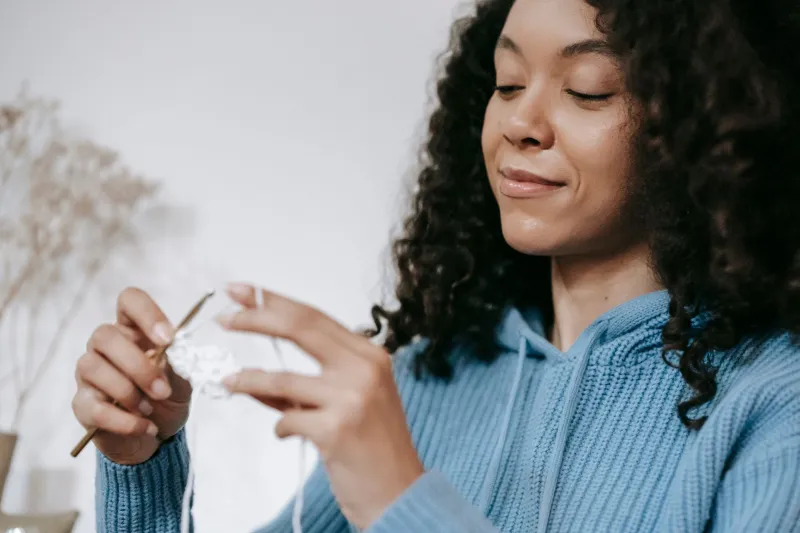
There's a moment a lot of crocheters know way too well. You're humming along on a project, feeling good, and then — you spot it. A slightly looser stitch from two rows back. A join that looks a tiny bit crooked. A color stripe that's maybe one row off from where you intended.
And just like that, the scissors are in your hand and you're frogging the whole thing.
Sound familiar? You're in good company. But here's the uncomfortable truth: that impulse isn't really about quality. It's about fear. And once you name it, you can start to work with it instead of letting it run the show.
Why Crocheters Are Especially Prone to This
Crochet is a craft built on repetition. Every stitch connects to the last, which means it's very easy to see your work as a chain of decisions — and every imperfect decision as a flaw that's permanently locked in. Unlike, say, painting, where you can blend or layer over a mistake, crochet feels more visible. More accountable.
Add to that the fact that most of us learned from patterns, tutorials, and finished objects that look immaculate in photos (hello, professional lighting and blocking magic), and it starts to make sense why so many makers hold themselves to an impossible standard.
Sewing teacher and fiber artist Dani M., who's been crocheting for over 15 years, puts it plainly: "I used to think every project had to look like it came out of a magazine. I'd frog something five times and eventually just abandon it in a bag. It took me a long time to realize I wasn't protecting the project — I was just avoiding finishing it."
That's the trap. Perfectionism looks like high standards, but it often functions as a way to stay in the comfortable middle of a project — where it still has potential — rather than finishing and finding out it's just... good.
The Imperfection Nobody Else Sees
Here's a question worth sitting with: when was the last time someone else pointed out the flaw you ripped out your work to fix?
Probably never.
The stitch you're agonizing over is invisible to anyone who isn't you. Your finished sweater, worn on your body, in motion, in real light — no one is going to crouch down and inspect row 14. And even if they did, a slightly uneven stitch in a handmade garment isn't a defect. It's evidence that a human being made it.
That's actually the whole point.
Mass-produced clothing is uniform because machines made it. Your crochet is slightly irregular because your hands made it, and your hands were affected by how tired you were, what you were watching on TV, whether the cat was in your lap. That variation is the fingerprint of the maker. It's not a bug — it's a feature.
When Perfectionism Becomes a Finishing Problem
The most concrete damage perfectionism does isn't to the quality of your work. It's to your ability to complete things.
If you've got a pile of unfinished projects (and most of us do), it's worth asking honestly: how many of those stalled because you hit a point where the work stopped feeling perfect and you lost momentum?
Perfectionism and procrastination are close cousins. When we can't do something flawlessly, we often stop doing it entirely. We tell ourselves we'll come back to it when we have more time, better yarn, clearer instructions. But "better conditions" rarely arrive, and the project sits.
The solution isn't to lower your standards — it's to recalibrate what "good" actually means in the context of a handmade object.
Practical Ways to Give Yourself Permission to Finish
Set a "one frog" rule. Give yourself permission to redo something once. If the second attempt is still not perfect, keep going anyway. This creates a natural stopping point for the ripping cycle.
Name the flaw out loud — then move on. Literally say (or write down): "Row 22 has a slightly loose stitch." Acknowledging it and consciously choosing to continue is a powerful act. It shifts you from passive anxiety to an active decision.
Look at your work from a distance. Step back. Hold it at arm's length. Take a photo and look at the thumbnail. Most flaws that feel enormous up close completely disappear at normal viewing distance.
Compare to store-bought, not handmade-by-pros. A lot of us compare our work to expert makers with decades of experience. That's a rough benchmark. Compare your handmade cardigan to a $40 fast-fashion version and I promise yours wins.
Finish something imperfect on purpose. Pick a low-stakes project — a washcloth, a small pouch, a dishcloth — and commit to finishing it without frogging anything. It's a practice run for letting go, and it builds the muscle.
The Projects That Taught Us the Most Weren't Perfect
Ask any experienced crocheter about their most meaningful finished object, and odds are good it's not the technically flawless one. It's the lumpy first hat. The blanket with the section that went sideways. The sweater that came out a size too big but gets worn constantly anyway.
Those are the projects that stayed. The ones that got finished despite the imperfections — or maybe because of them.
Crafter and Etsy seller Renee T. shared this: "My most-loved piece is a granny square bag I made when I was still a beginner. The squares don't all match perfectly. The strap is a little uneven. I've made a hundred better bags since then, but that one sits on my shelf because it reminds me that I can do hard things even when they don't come out perfect."
That's what finishing gives you. Not a flawless object — a real one.
Good Enough Is a Skill
Learning to recognize when something is genuinely good enough — and stopping there — is actually a craft skill, not a compromise. It takes practice, and it takes some trust in yourself.
Your handmade work is beautiful because you made it. The slight variations, the human marks, the evidence of your hands and your time — that's the whole value of handmade. Chasing machine-level perfection in a handcrafted medium isn't a high standard. It's a misunderstanding of what the craft is for.
Finish the thing. Wear it, gift it, use it. Let it be good. That's more than enough.